
Carbon Footprint Reporting
Climate-related risk and the complex environmental, social and economic challenges that come with it are impacting our company, clients and communities. To demonstrate our commitment to climate change mitigation and environmental stewardship, we maintained our carbon neutral status in 2025.
Operational Decarbonization
We have an interim target to reduce the emissions of our operations by 45% between 2019 and 2030, before achieving net zero no later than 2040. These targets include mandatory scope 1 and 2 emissions, in addition to several categories of scope 3 emissions.
Gross reduction in carbon emissions since 2019: 35.8%
Our operational carbon emissions since 2019*
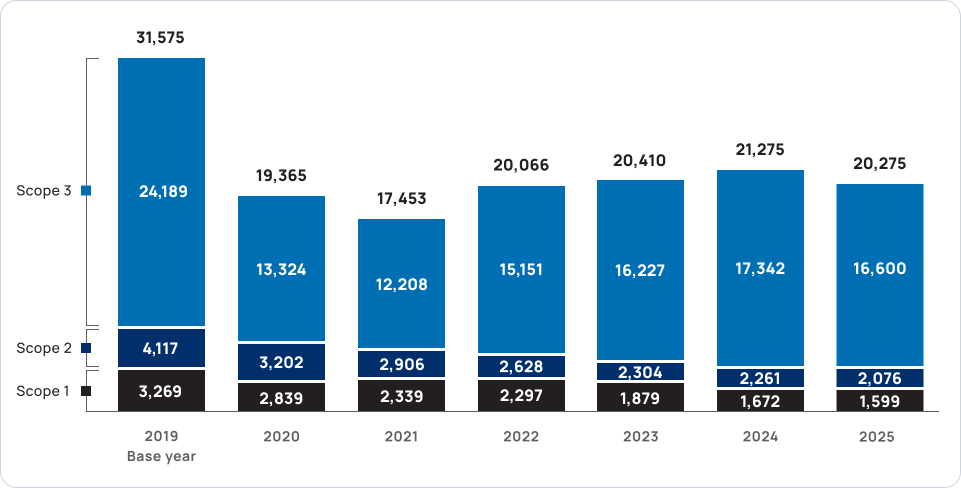
Units: tonnes of carbon dioxide equivalent
*Results for 2019 to 2024 have been restated. The most significant change was a methodological change in the calculation of air travel emissions, where a newly recommended lower radiative forcing factor was applied to all previous years. There were also small restatements related to a correction of square footage of one office, electricity emission factor updates and energy intensity updates.
Download the 2025 Climate Report for more information.Energy Consumption
| 2019 | 2020 | 2021 | 2022 | 2023 | 2024 | 2025 |
|
|---|---|---|---|---|---|---|---|
| Energy Consumption (GJ) | 130,670 | 114,793 | 101,241 | 98,246 | 84,740 | 77,028** | 73,616 |
**Result for 2024 has been restated due to the addition of missing data.
What we include in scopes 1, 2 and 3
Scope 1 and 2 emissions come from our corporate offices and our leased vehicle fleet. For scope 3 emissions, we focus on the sources that are most material to our business, and where we have reliable methods and data. This includes emissions from business travel, retail sales offices, commuting and working from home, as well as our Information Technology (IT) assets and services.
Our 2025 performance
At the end of 2025, our carbon emissions were 35.8% below 2019 base-year levels and were lower than those in 2024. Increases were seen in commuting and working from home, which were related to increased business activity and an increased presence in corporate offices. These were counteracted by a significant decrease in emissions from IT assets, because our major vendor revised its product carbon footprint methodology, and due to small decreases associated with corporate office energy consumption, air travel and IT services.
In 2025, we continued to work within business areas across the enterprise to identify and implement initiatives that drive us toward our net-zero commitment. We conducted a second targeted IT vendor survey, focused on carbon emissions. We produced an analysis showing that our reduction in air travel emissions (since our base year) could make a significant contribution toward meeting our interim target, if those emissions don’t increase. The report encouraged a mindful approach to business travel, including consideration of the need to travel as well as travel alternatives, such as taking rail or holding events virtually. Reaching our targets will require a collective effort from across our organization, and the action of society as a whole. We’ll continue to seek opportunities to reduce emissions internally, while advocating for value chain and societal change.
As we seek to meet our net–zero targets, we continue to maintain carbon neutrality through carbon offsets that have been verified to a recognized standard and that are listed on a public registry to ensure quality. More information on these standards can be found online in our Climate Report. Additionally, we review project documents and scan media to further ensure that we’re focusing our purchases on renewable energy certificates and offset projects that have not been identified as having quality concerns. Our offset purchases in 2025 included an IT assets reuse project and safe drinking water projects.
Linking net zero performance to executive pay
Achieving net zero is a long-term goal that is held as one of our organization’s key priorities. To drive accountability and encourage emissions reduction, we have directly tied our net-zero operations target to executive compensation. This means that the long-term incentive plans for our president and CEO, as well as all vice-presidents and executive vice-presidents, are linked to progressing toward our net zero operations goal.